


I was born in Africa and spent my childhood in Cambodia, Vietnam, then between Abidjan and France. As an adult I kept travelling a great deal, became an interior architect (projetsinterieur.fr) and met Diana. For the first time since childhood, I was learning a country from the inside. Sharing the intimate life of a people so different, so humanly close, endowed with such kindness, touched me to the depths of my soul. I have always dreamt of being a bridge between the worlds that make up our humanity, and this project, now a reality, allows me to do just that. That is why we created chezmamang.
The road is long and winding, wide at times, then narrowing wherever rocks have fallen.
From Naval it takes 20 minutes by motorbike to reach Talahid; as you arrive, Thelma’s house is right by the first bus shelter on the left. There are, incidentally, no buses on Biliran, but plenty of bus stops.
Like every village on Biliran, and probably in the Philippines, there are many small houses, 40 or 60 m², made of wood, corrugated iron and linoleum! Streets with no apparent layout along the water’s edge and, in the upper village, under the trees, Mamang’s house.
A light breeze cools the house; Thelma works under the zinc porch. Facing the sea, the air is mild. As usual, she wears pyjama bottoms as trousers, which turn out to be well suited to this climate as daywear. The patterns on the fabric do not seem to be a concern…
The sewing machine clatters along at an almost steady rhythm, except for a few adjustments during which the sound of the television resurfaces. Cartoons all the time: Japanese, American, Filipino, but nothing Chinese or European.
The weather is fine, the sun is shining, the sea is blue and fairly calm despite the light wind. Wedged between the road and the sea, backing onto other houses, this one does not look out of place. Lined up along the street, each house tries to claim a little view and air.
Little or no land, but plenty of plants, neatly arranged; nature is here, disciplined in salvaged plastic pots. In Europe we would call it recycled; here it is simply salvaged to spend less.
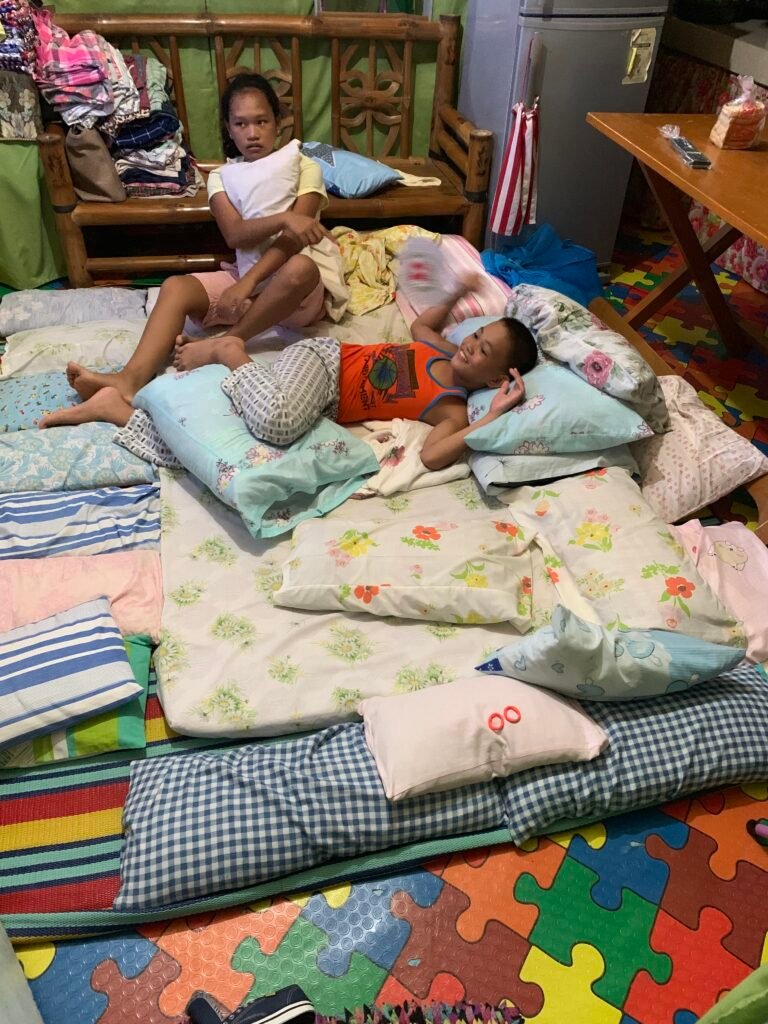
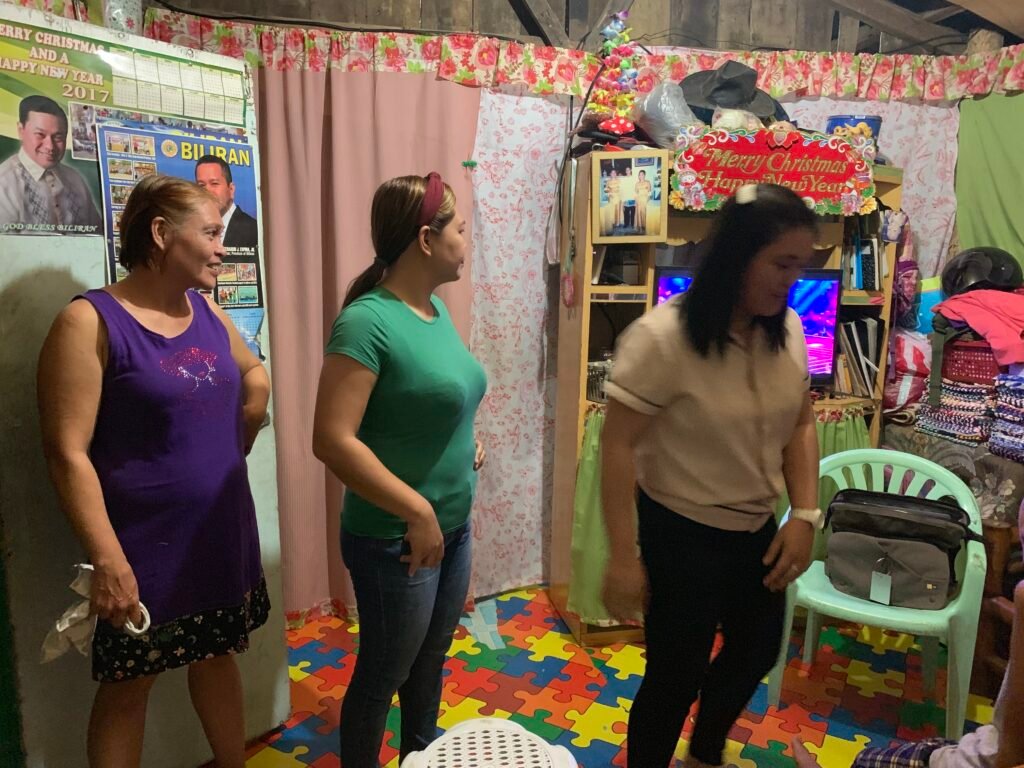
A few roughly hewn wooden posts, beams gnawed by vermin, a corrugated iron roof partly lined with sheets of plywood, walls covered in floral fabric, and on the floor cracked lino with a children’s jigsaw pattern.
Thelma’s house has only two rooms. The back one has no window, but you can feel the air flowing through the wall of ill-fitting planks. It is the bedroom, the dressing room, the place where the cushions that serve as mattresses are not necessarily put away; a curtain closes off this one room where you can be alone.
In the main room, the entrance, the dining room and the second bedroom are functions that fold up, tidy away and unfold according to the activities of the day.
The television takes pride of place, and so does the fridge; in the evening out come the cushions that will form the huge mattress where those who sleep in this room will lie.
Behind, down a big step, is the water, with all it makes possible. The bathroom consists of a tap and a toilet with no seat and no flush. A small square room with a light grey tiled floor whose main utensil is the bucket. It is used to flush the toilet, to clean the floor and as a reserve for washing. It is the least cluttered room; you can still see the walls.
Here and there, a few shelves for a multitude of soaps, shampoos and conditioners, in various forms but often in single-use sachets, like samples the West would not have wanted.
The kitchen is the only way through to the bathroom, and the floor you have to cross is rough, unfinished concrete, hard to wash and therefore seldom washed, often dirty.
The sink on one side, fed by a municipal plastic pipe and its bare-bones tap; on the other, in an alcove, the gas rings, surrounded by a surface so covered in black that you cannot tell what it is made of. This is where Thelma cooks for everyone in her household.
Thelma lived with her husband, Jun (Junior), their son and their two daughters, happily. John-Ray was the first to leave, to study in Quezon, then May-Flor left to live with Jonathan, leaving with Thelma a child born of a brief romance at 16. Still happy, the family grew smaller; two children remained, Rose-Vi and Nel-Nel (May-Flor’s son).
Jun died in a motorbike accident while taking Thelma’s mother to Almeria. Mamang did not survive the accident either.
Rose married six months later and only lives in the house now and then, when her policeman husband is posted too far away. But Filipinos do not like emptiness, and there is often no half measure…
So Thelma’s house is now home to Michaël, a 20-year-old nephew who used to live at Mamang’s, as well as Hillary, 6, Diana’s daughter, and SofiaLoren, 13, a grandniece. Nel-Nel kept his place, joined by his cousin Rudy Jr, 13, whose very hard-up parents can no longer look after him, and finally Diana, Thelma’s sister, almost 20 years her junior and Hillary’s mother. Diana was working in Manila, but a little help was needed, and so she came to the rescue to manage this family, which went from 4 to 3 and then to 7 in a matter of weeks, or 8 on the evenings when Rose is there.
A balcony sheltered from the sky lets Thelma sew outside all day while looking at the sea. From pyjamas to curtains, Thelma earns her living sewing for others, a few pesos that top up the help sent by John-Ray.
When evening comes, the school empties and the house fills up. It is 5 o’clock, the procession of showers begins; in an hour everyone will be at the table, and at 8 the last lights will go out.
Until then, the rice will cook, the corned beef will be warmed up, then the washing-up done, the dining room cleaned and tidied to make way for the bed of cushions.
Tomorrow is another day, so similar, which will begin at 5, with no alarm clock, with the sun. At 7:15 the children will leave for the school nearby, which starts at 7:30 with sweeping the classroom.
Thelma will sew, Diana will tidy and wash, May Flor will come to lend a hand with the laundry, and Michaël will wait, as yesterday and tomorrow, lying in the back room, for someone to give him the money that, he says, will let him go to Cebu to find work.
Rose will go off to work; she found a job as a medical secretary at the hospital right after her OJT. There is no shortage of work for those who want it, but sometimes the will is lacking.
Then begins the parade of neighbours who, knowing that the “Kano” is here, come to cast a sidelong glance, while chatting with Thelma, at this foreigner hunched over his computer all day. Getting up only to stretch, gaze out to sea, kiss Diana or go shopping. I am something of a curiosity.
It must be said that at 40 you are often a grandparent here, and you easily slip on the checked slippers of someone who can finally claim to be wise on account of his age.
It is the rainy season, outdoor games are rare and Thelma’s 40 square metres are everyone’s refuge, a small house full of people, of life, of things, but above all of kinship and love.
In a single day Thelma’s world collapsed: an accident, no more husband, no more mother. There was emptiness, but here in the Philippines, emptiness does not exist.
Charles-Eric Guerrier

Leave a Reply